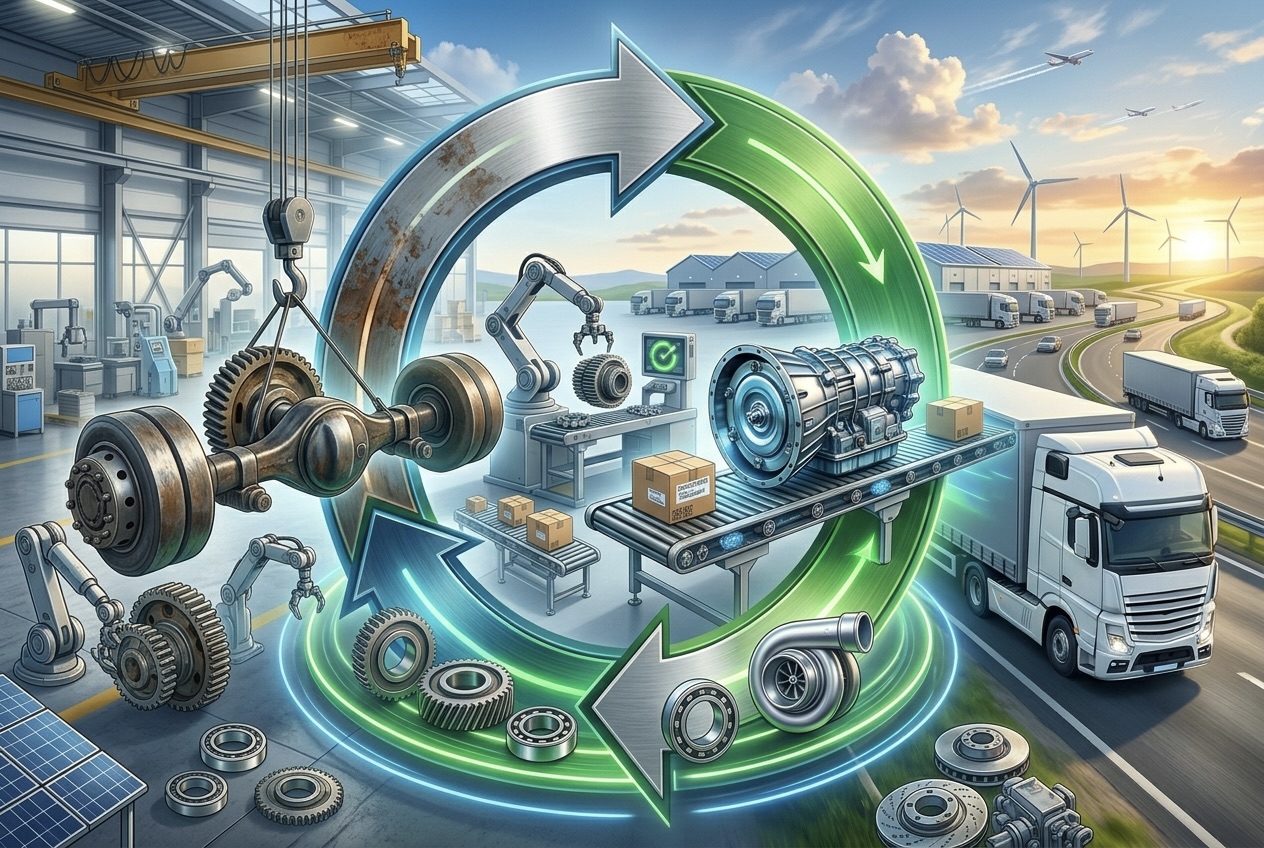
What does Onyarbi do with the recycling of materials and the reduction of the carbon footprint, the circular economy goes straight into Onyarbi Industries
To achieve this circular economy strategy, the heavy transport industry and the manufacture of its components face the greatest challenge of its recent history: decarbonisation and the transition to a sustainable industrial model. For decades, the sector operated under a linear scheme of “take, do, discard.” However, planetary resources are finite and the climate emergency requires a radical transformation. At Industrias Onyarbi we have assumed this challenge not as a regulatory imposition, but as a fundamental strategic pillar of our corporate identity through the circular economy.
Applying the principles of the circular economy to the manufacture of heavy components – such as axles, brake drums, suspensions and steering systems – requires a complete redesign of production processes. For Onyarbi, this translates into keeping materials and products at their highest level of utility and value for as long as possible, minimising the extraction of virgin raw materials and drastically reducing our carbon footprint.
Ecodesign: Thinking about the end from the beginning
The circular economy does not start at the recycling plant, but at the drawing table of our engineers. In Onyarbi Industries we apply eco-design criteria in the development of each new component. This means designing parts that are not only extremely resistant and safe, but also easy to disassemble, repair and ultimately recycle at the end of their useful life.
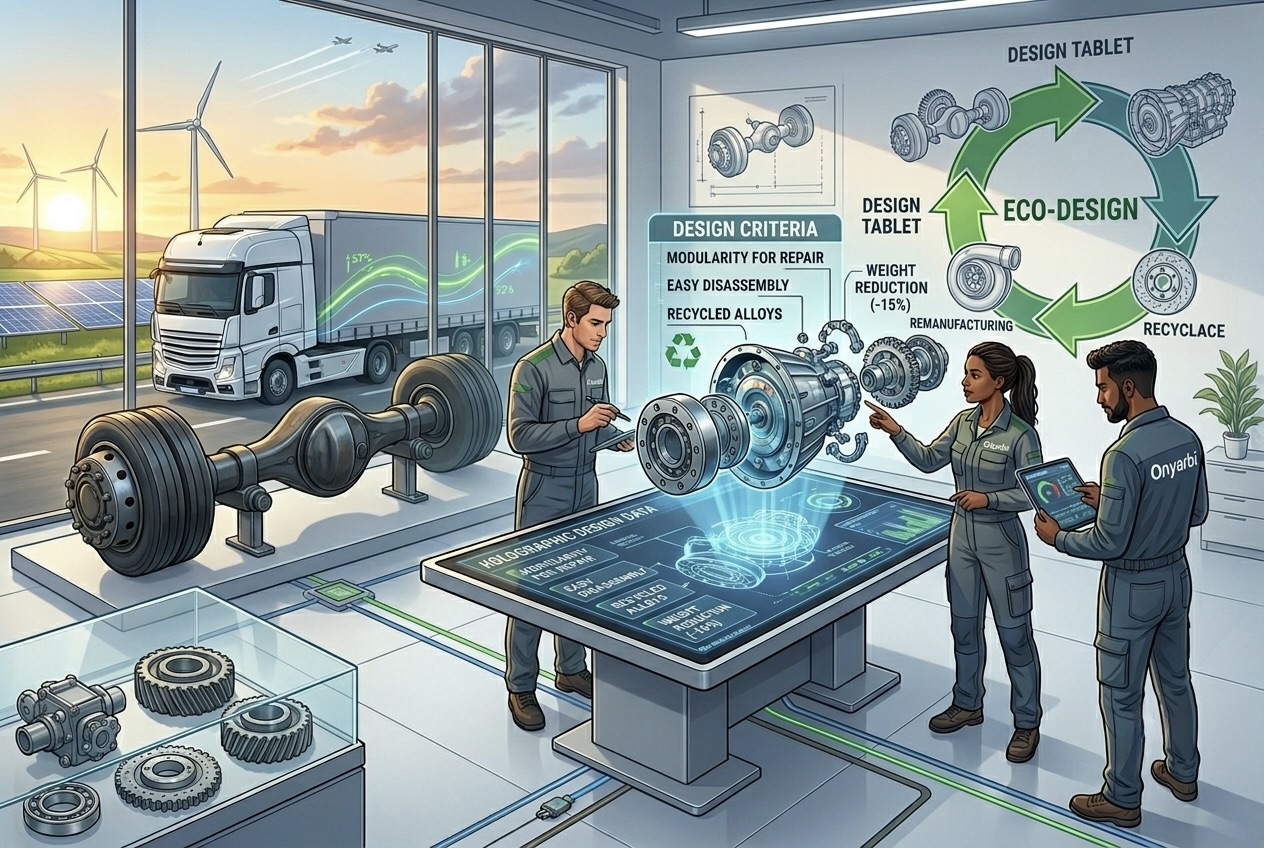
Reducing the weight of the components by using advanced high-strength alloys is another of our design priorities. A lighter component in the trailer reduces the fuel consumption of the truck for thousands of kilometres, which reduces the operational CO2 emissions of our customers. It is a bidirectional sustainability strategy: we reduce the impact on manufacturing and help reduce it in the exploitation of the vehicle.
Efficient management of materials and high-value recycling
Metal casting and machining are resource-intensive processes. At Onyarbi we have implemented a zero waste system in our machining processes to meet high standards of circular economy:
• Recovery of metal shavings and cuts: 100% of the steel, casting and aluminum chips generated in our machining plants is classified, compacted and reintroduced into the casting chain. This avoids the need to process new iron ore, a process that consumes up to 75% more energy than the recycling of existing metal.
• Closed cycle of industrial fluids: The cutting oils and drills used to cool and lubricate the machines are treated and filtered in closed circuits to extend their useful life, reducing the generation of hazardous waste and guaranteeing zero discharge.
• Reverse packaging logistics: We work with our customers and distributors to recover pallets, metal containers and specialised packaging, reintroducing them into the logistics circuit and eliminating the use of single-use plastics.
Carbon Footprint Mitigation and Energy Efficiency
For Onyarbi Industries, measuring is the first step to improve. We periodically evaluate our carbon footprint according to international standards, analysing from the direct emissions of our factories (Scome 1) to the indirect emissions derived from the energy consumed (Scome 2) and the supply chain (Scome 3).
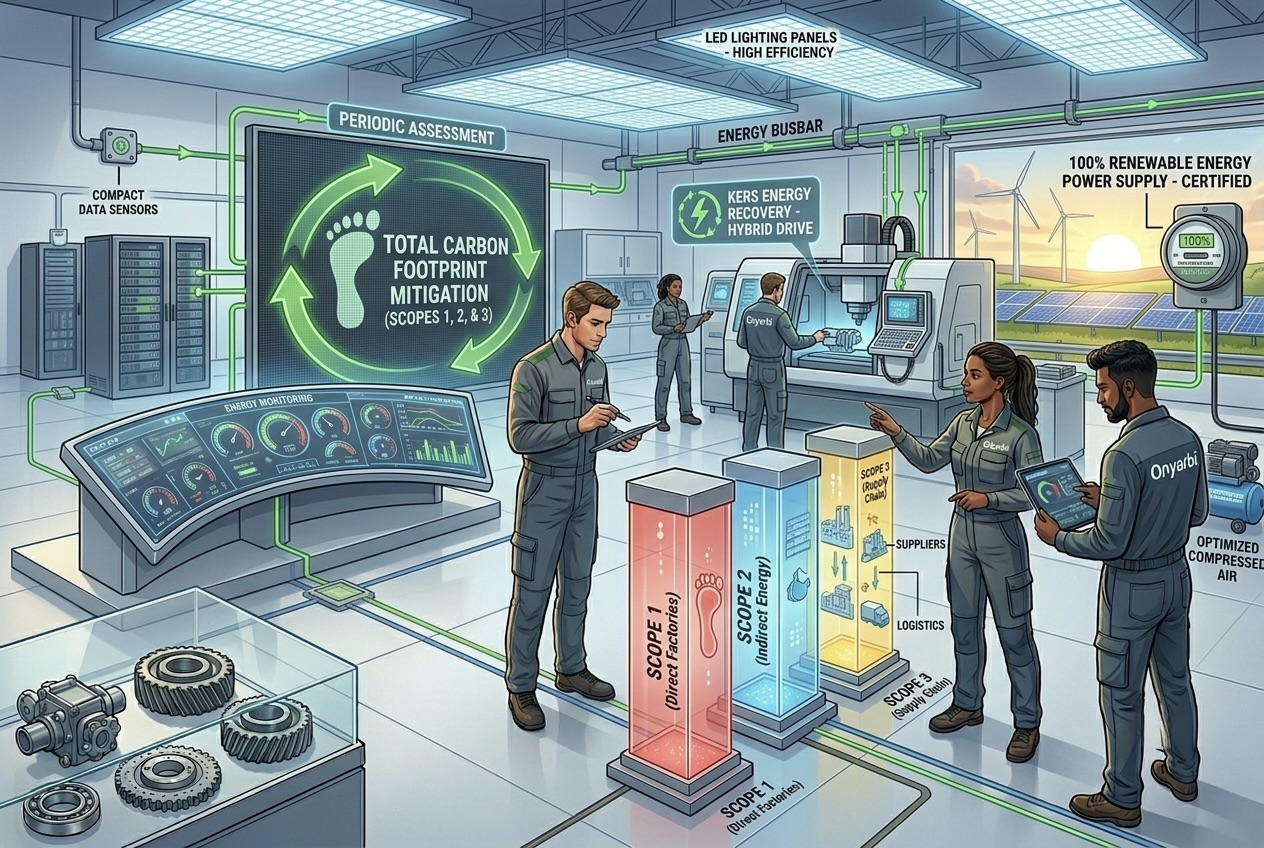
To reduce this impact, we have implemented a series of energy audits that have resulted in the transition towards high-efficiency LED lighting systems, the optimisation of compressed air systems and the renewal of our machinery by hybrid or all-electric models with kinematic energy recovery systems. We also prioritise the supply of electricity from 100% certified renewable sources.
Remanufacturing: Giving a second life to the components
One of the most advanced pillars of the circular economy in Onyarbi is our firm commitment to the remanufacturing (or reconstruction) of components. Unlike simple recycling – where the component melts to start over -, remanufacturing recovers the worn part, subjects it to industrial cleaning processes, technical verification and replacement of wear elements, returning it to the market with the same performance, safety and warranty specifications as a completely new part.
This process saves up to 80% of the energy and material needed to manufacture a part from scratch. By offering high-quality remanufactured components, Onyarbi provides fleets with an economically and ecologically responsible option, demonstrating that sustainability and business profitability can, and should, go hand in hand. With every component that returns to the road, Industrias Onyarbi reaffirms its commitment to a cleaner, more efficient and circular future.