Road transport has historically been the arteries through which the global economy pumps. Millions of trucks and trailers cross entire continents every day to ensure that goods reach their destination. However, the sector is on the threshold of the deepest transformation since the invention of the combustion engine. This time, the revolution is not only mechanical or fuel; it is digital, cognitive and deeply technological.
Artificial Intelligence has ceased to be a science fiction promise to become the undisputed engine of modern transport. From autonomous driving to intelligent warehouse management, AI is hitting with unprecedented strength, reconfiguring the efficiency, security and sustainability of global fleets. For those of us who are part of the supply chain, manufacturing and commercialisation of replacement components, this new paradigm not only changes the way trucks operate, but also the way in which their structural parts are broken, maintained and managed.
The Impact of Artificial Intelligence on the Route: Efficiency and Autonomous Driving
When we think of Artificial Intelligence applied to transport, the first thing that usually comes to mind are driverless trucks. Although Level 5 vehicles (total autonomy in any scenario) are still in regulated test phases, the intermediate level range is already integrated into the roads. Advanced driver assistance systems (ADAS), powered by artificial neural networks, process terabytes of information per second through cameras, radars and LiDAR sensors.
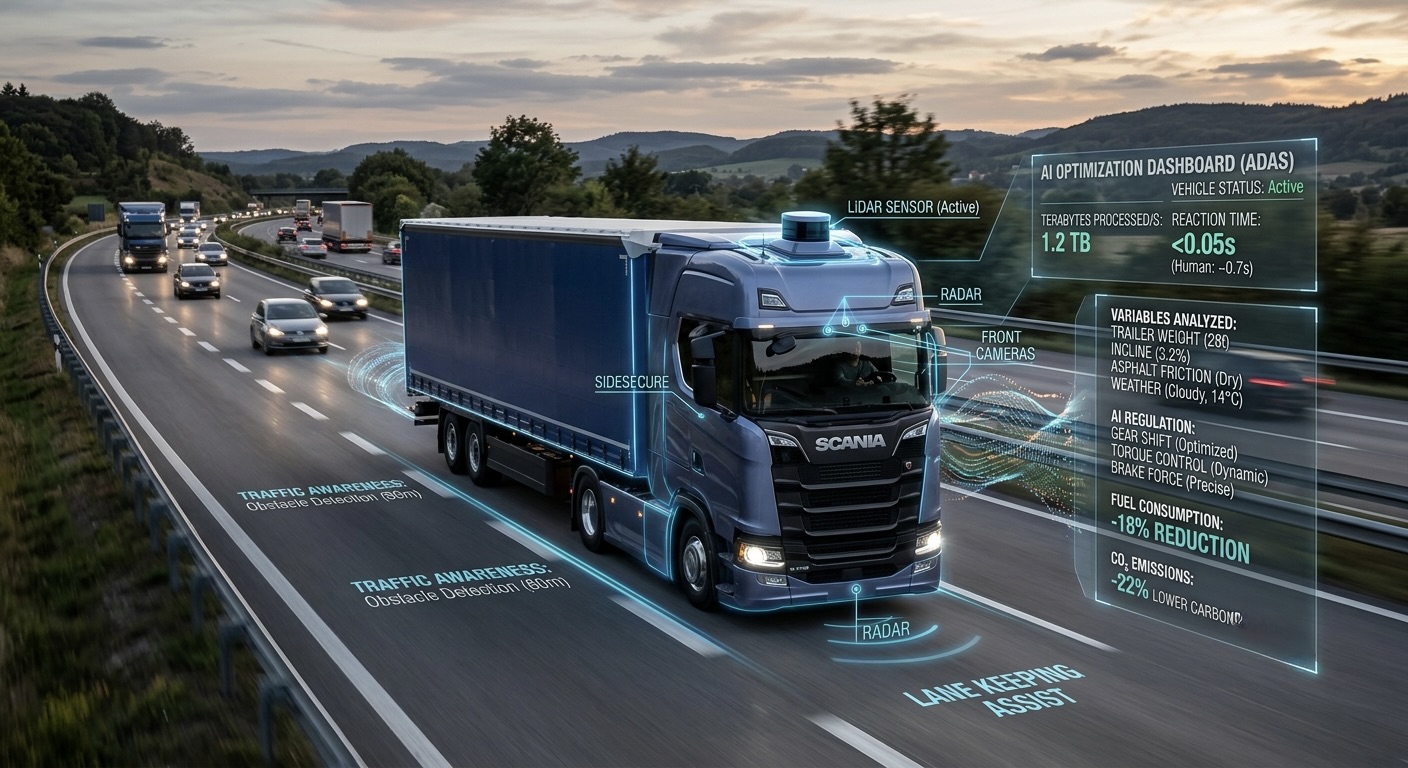
These algorithms not only react faster than the human eye to an unforeseen braking, but they optimise driving in a way that a traditional operator could hardly replicate. Analysing physical variables in real time – such as trailer weight, slope inclination, asphalt friction and weather conditions – Artificial Intelligence regulates torque, gearbox transitions and braking system strength. The direct result is a drastic reduction in fuel consumption and, consequently, a lower carbon footprint, a critical factor in a sector under pressure from international environmental regulations.
From the Reactive Workshop to the Predictive Maintenance: The Paradigm Shift in the Components
For companies dedicated to the design and distribution of components and spare parts for trucks and trailers, the most revolutionary change in Artificial Intelligence lies in predictive maintenance.
Traditionally, the replacement of parts has been governed by two methodologies: the reactive (changing the part when it breaks, with the consequent cost of the crane and the inactivity time of the vehicle) or the preventive (changing the part when completing certain kilometres or months, assuming that components that still have useful life are often discarded).
Artificial Intelligence destroys both inefficiencies through predictive data analysis. Modern trucks act as rolling data centres. Strategically placed sensors measure the temperature of the bushings, the abnormal vibrations in the suspension system, the micro-losses of pressure in the pneumatic system or the millimetre wear on the brake callipers of the semi-trailers.
Through Machine Learning models, these massive data flows are compared with historical failure patterns. The algorithm can predict days in advance that a specific pneumatic valve will fail due to an anomalous thermal degradation. This allows you to program the stop of the truck exactly in its logistics route, requesting the specific replacement before the vehicle steps on the workshop. The supply chain becomes proactive: the right replacement waits for the truck, and not the other way around.
Vanguard in the Supply Chain: The Commitment of Onyarbi Industries to AI
At Industrias Onyarbi, with a solid track record specialised in high quality spare parts for industrial vehicles and trailers, we understand that technical innovation cannot be limited only to the metallurgical design and precision tire of our parts. The excellence in the service of the 21st century requires us to be as agile in software as we are in automotive hardware.
Aware that the spare parts market requires absolute immediacy to prevent a fleet from being paralysed, at Onyarbi Industries we have begun to implement and deploy systems based on Artificial Intelligence in our internal processes. Currently, we are using advanced Artificial Intelligence tools to optimise our stock management and intelligent warehouse flow automation, crossing macroeconomic variables, logistic route seasonalities and technical wear histories to predict the exact demand for key components, such as bushings, steering components or pneumatic repair kits.
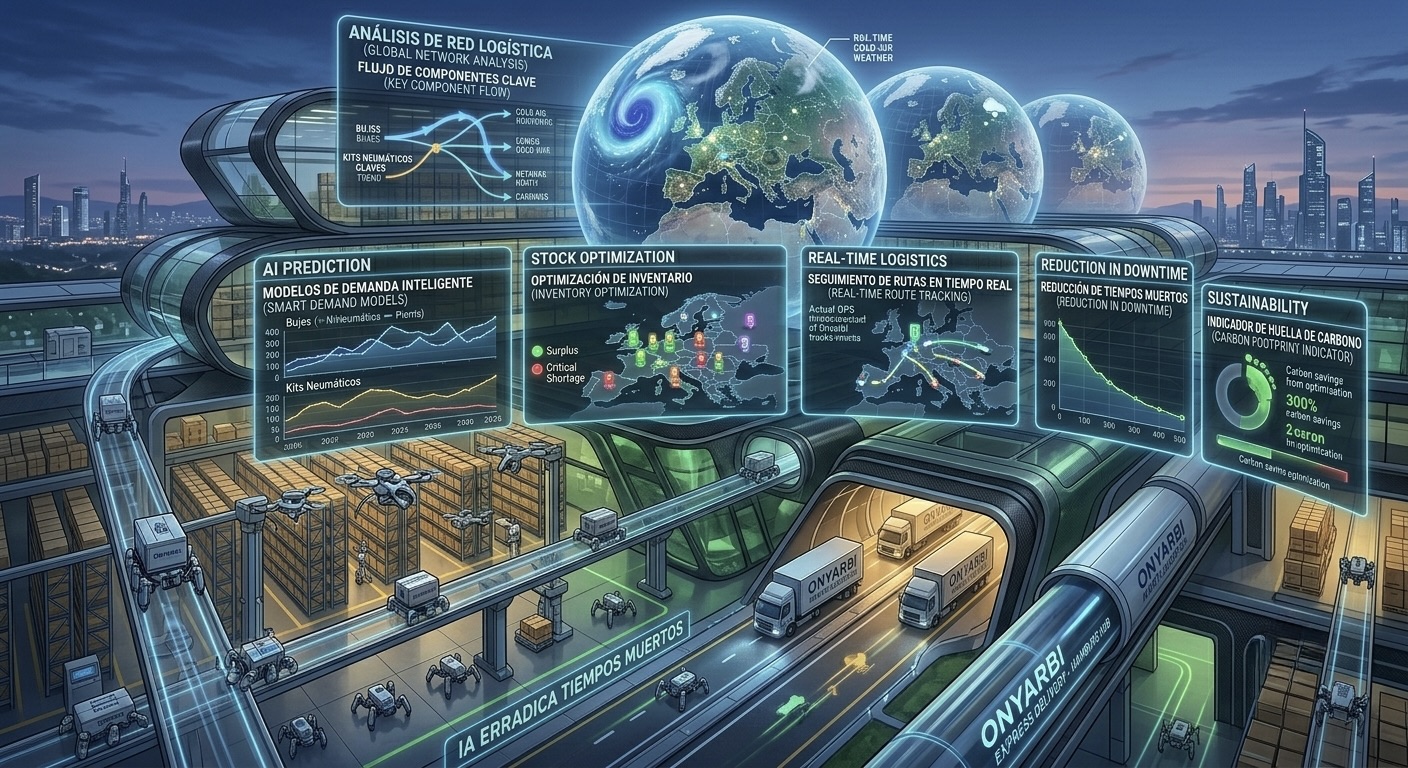
Management Note: This initial deployment is only the surface of a much deeper technological transformation that we are experiencing in our facilities. Given the technical depth and structural benefits that these measures are bringing to our distribution network and associated workshops, in a future article we will analyse extensively, in detail and in depth how Artificial Intelligence is redefining each internal gear of Onyarbi Industries, detailing the algorithms used and the next milestones of our digital roadmap.
The Smart Trailer: The Forgotten Twin that Takes Control
Historically, the trailer or semi-trailer has been seen as a purely mechanical structure, a “passive” extension attached to the tractor head. Artificial Intelligence is radically changing this perception. The Smart Trailer is already a reality.
The distribution of the load in a trailer is vital for safety. A poorly levelled load can cause critical braking behaviour or a rollout in tight curves. Today, intelligent air suspension systems governed by Artificial Intelligence process dynamic load readings on each axis and adjust the pressure in a millimetre shape in milliseconds during the march. By connecting with the electronic stability control system, the trailer’s AI can predict a scissor effect long before the driver perceives the physical instability, selectively activating the semi-trailer’s disc brakes to correct the trajectory of the entire assembly.
For our industry, this means that traditional components (such as brake chambers, shock absorbers and regulating valves) no longer work in isolation. They must interact fluidly with complex electronic interfaces that receive orders from an artificial brain, which raises the requirements of certification, quality and tolerance of each component that leaves the factory.
Logistics, Storage and the Factory of the Future
The impact of the AI force does not stop when the truck arrives at its destination; it extends throughout the fabric of global logistics. Intelligent automotive parts warehouses use predictive AI algorithms to geographically redistribute parts before even local workshops place the order.
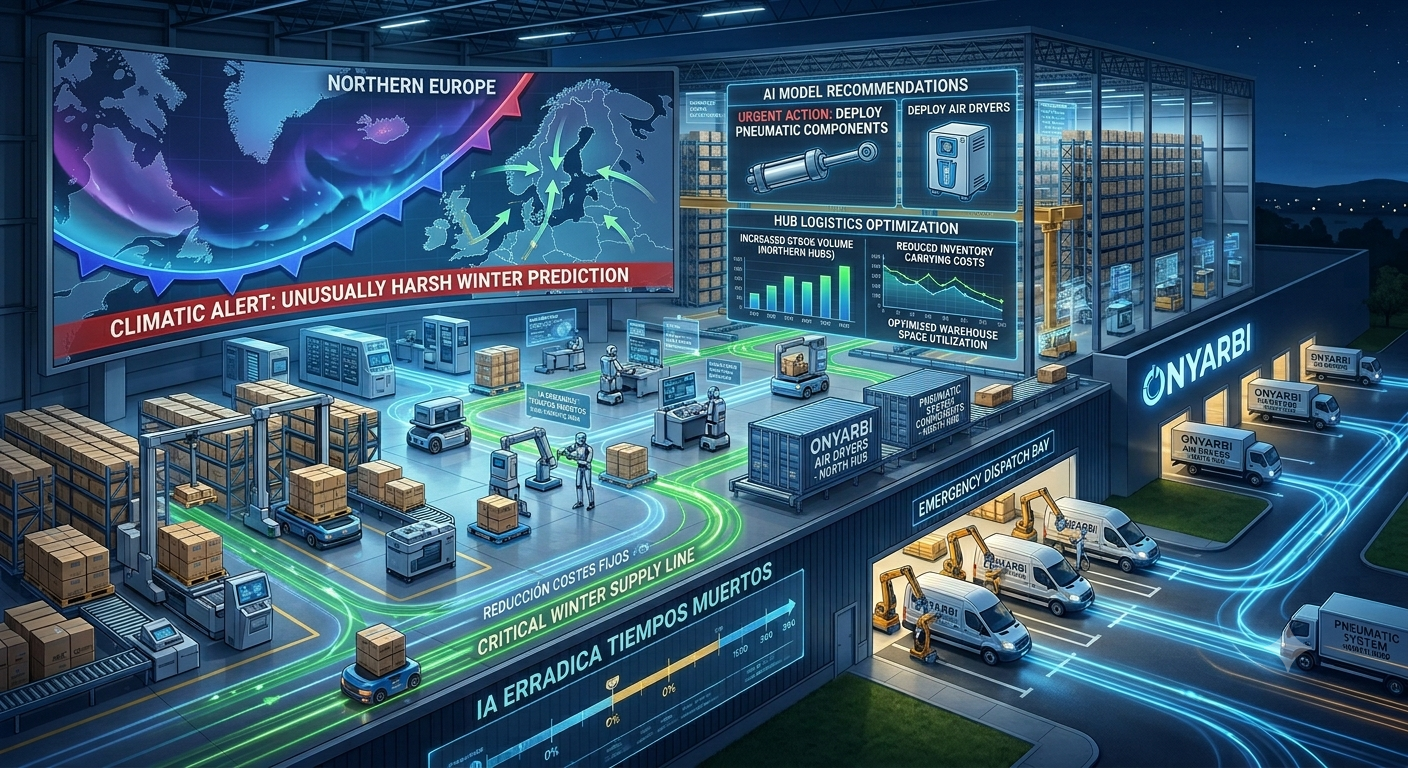
If climate data and trends show an unusually harsh winter in certain regions of northern Europe, predictive models recommend moving larger volumes of pneumatic system components and air driers to the logistics hubs of those geographical areas. AI eradicates downtime for the transport of inactive goods and optimises the use of physical space, reducing fixed inventory costs.
Conclusion: Towards a Safer, More Efficient and Connected Road
Artificial Intelligence does not replace the mechanical heart of the trucks and trailers that move the world; it comes to provide them with a brain capable of maximising their performance, prolonging their life cycle and ensuring the safety of all those who share the asphalt.
The future of road transport draws a fascinating panorama where mechanical wear will no longer be an indomitable unforeseen event, but a perfectly controlled mathematical variable. In this new digital ecosystem, the technical quality of the classic metal and rubber replacement must be perfectly fused with the accuracy of the data. The companies in the sector that know how to interpret this change, adopting AI not as a passing trend but as the definitive industrial standard, will be the ones that continue to lead and move the roads of tomorrow.